 Here is the front lawn in spring ’22. Now we see that all of our work last year is worth all of the effort. Pete has just mowed so I went out to take pictures showing how the grass seed grew in quite well.
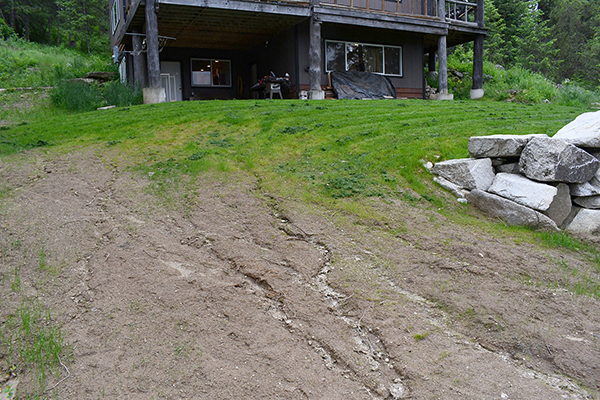 Not all drainage problems are dealt with yet at the base of the rock walls but the largest majority of it is so much better now. Above is an example showing how much better the erosion is controlled where the grass is planted vs bare ground.
In the middle is our own “grassy knoll” pun intended. I put dead furrows on the downward slope of this hump of dirt between the trees. Wildflower seed is planted there but not yet sprouted. I transplanted extra flowers, mostly red poppies, from the garden in rows also.
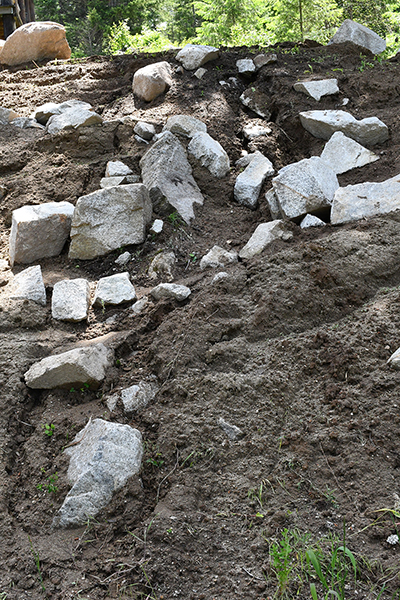 You can see that one breakthrough in water drainage occurred after last night’s rain. It made a gulch right down the center of the mound. The seed and tiny transplants only can hold so much. Everything that can be done is complete at this point. Now, we will have to wait for the warmth of summer to help get things sprouting, growing, and holding the soil in place.
 The west rock wall will be sloping down to our driveway when it is all done. Landscaping-wise, it starts off looking somewhat unremarkable with the first rows laid. The base has the largest boulders that the tractor can move. What is unexpected is that the rocks are placed with their longest sides laid flat for increased stability. The rise in height is slower this way, but the goal is to put enough strength and weight in the structure to withstand nature.
 See the large flat stone at the end on the right? This was pulled into place with a chain across the hill. There are intentional gaps in the wall allowing for drainage. Remember, no one wins a war against nature. Water always wins, so it is important to invite it to a place you want it to go.
 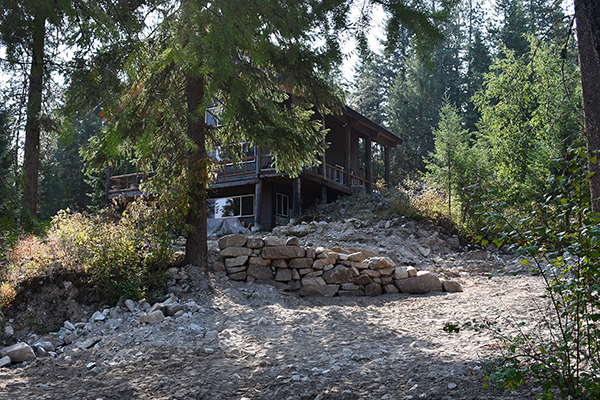 With this view, you can see how the land has natural rock outcroppings stepping up the hill. A lower 10-foot rise where we are building the rock walls and another 10-foot rise behind next to the house, that we have made into a rock garden.
 This process took all summer long to complete two walls last year. It was not a job that was hired out to a landscaper as we sat drinking tea on the deck and watched. You don’t have to be rich, just be willing to go out every day and get dirty and sweaty. Nose to the grind-stone. We can do almost anything if we have the where-with-all to put the effort out and the stick-to-it to finish it.
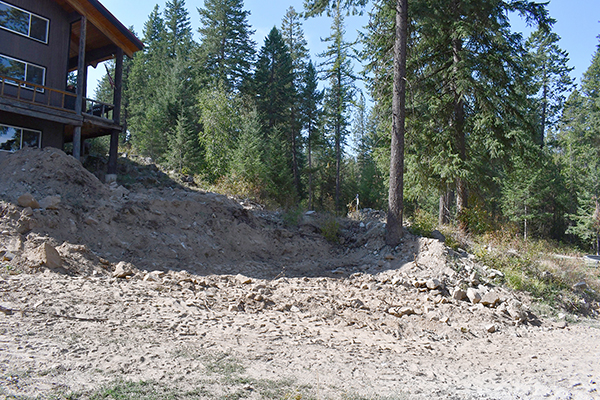 The east rock wall base is level now for the first course of rock to begin. We have a rock wall on the east side slope and on the west side slope with a mound of dirt in the center between the two big fir trees. This side of the lawn will have a slope going down to the road to our garden below.
 We leave a big enough gap between our fir tree and the wall to not cause it any harm. The largest boulders are the base of the retaining wall with gaps for the wet stuff to drain through.
  We love the tractor, and only wish that we had purchased it earlier. It has made a lot of this work a lot more doable. There is still a lot of hard hand work to place these guys so they don’t slip around.
 There is an area on the lawn side of the wall where smaller rocks are placed to help retain the soil yet still preserve the draining capabilities.
  Pry bars and gloves and Mr. Kubota are our friends for this project.
 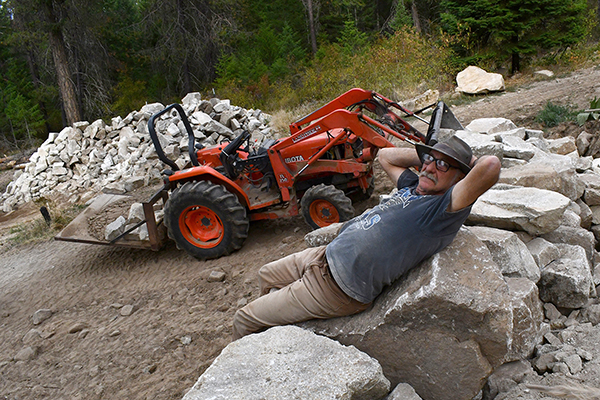 Peter found a boulder that is perfect to recline on, so it was put on the top of the wall for anyone to use if they happen to notice it.
 There are also rocks that have great prehistoric marks in them mixed in the wall. We had an archeologist tell us what this one is in-depth.
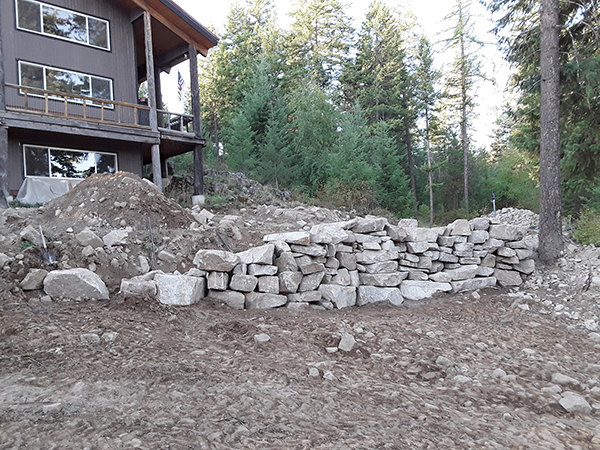 Here is the wall almost complete.
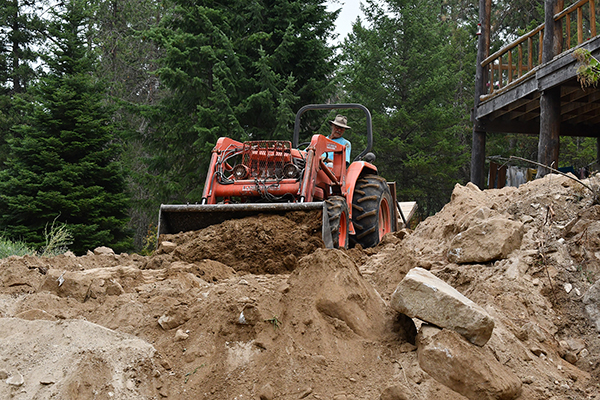 Before we can fill for the lawn landscaping we have to try to level out the existing area. You know, push the high spots into the low spots and discover where there are rocks. We have a plethora of boulders at the Woelk’s in Elk. They vary in size from human pickup-able to nothing short of dynamite can move me.
 There are two majestic firs in the middle that have a large mound of dirt between them. We have to leave this dirt so our main water line remains at least 5 feet below grade or we will have broken water pipes in the winter. The building code calls for 4 feet of cover but we have learned the hard way over the years to go the extra foot. Fixing a water line in freezing conditions is not a fun way to spend a day.
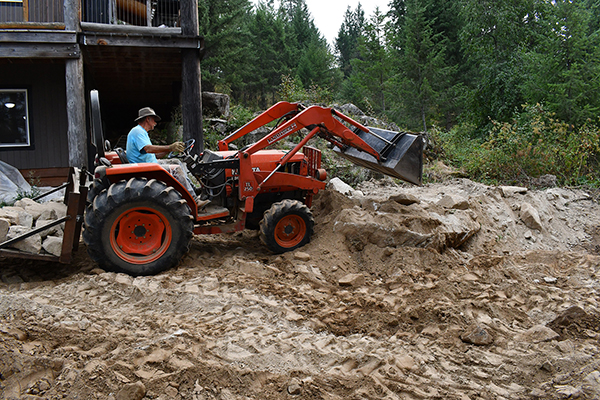 Peter discovers a dynamite daring boulder on the south side of our house. It is bigger than our Kubota and will simply remain right there. Our landscape will incorporate that into the rock garden above. Besides, it is probably part of that rock garden anyhow.
 Walking back up to the house after a hard day of work, my husband has finished leveling and making a flat base course area for building the rock retaining walls below.
 Pete discovered a playground rock, during rock wall adventures in the landscaping project. Sometimes run into a really large boulder that asks to be made into a piece of solid playground equipment. That is what happened this week. This giant had to be moved so we could cut a dead tree down which is where we are going to build a rock wall in front of our house. Etc Etc Etc.
 How many tires are actually on the ground as Pete moves it around with the Kubota? As we move this heavy rock, notice the squished front tires when the rock is being pushed. Do you think it just maybe a little beyond this piece of equipment’s capacity? Sure hope this little tractor is up to the test.

 Roll, roll, roll. Push, then tilt.
 This granite guy has a flat top just perfect for climbing on, and two stairs on one side with a single stair on the other, it’s perfect for the lawn area. It is truly a climbing piece of playground equipment. The grandkids have already tried all the surfaces out for us.
 The rock movers union has a new member here at the Woelks in Elk. All it takes is to be an expert “operator” of equipment or be a rock mover by trade. Really, just ask Pete! You too can become a member of the Rock mover’s union and learn how to make a Ph. D pile of rock just like this. Are you wondering what a Ph. D pile is? Here is a quote from Pete, “It is a stack of rock Piled Higher and Deeper!”
 BTW. Expert, as defined by my father, is a drip under extreme pressure.
 Here is a pictorial sequence of hooking up to move a big rock with a tiny garden tractor and a chain. Simple, really! Sometimes you have to start with digging a little to be able to reach underneath and put the chain around it.
 Then you hook the chain to the bucket and start to back up real slow and pulllllllll.
 I can see this little orange Kubota sweating as it strains.
 Look at how interested Max is in seeing the rock move. Not even a little bit.
 When it reaches where it is going to rest, for now, placing a rock under one edge allows us to easily hook a chain around it next time without having to dig under it.
 Okay, now imagine doing that all day long. Fun!