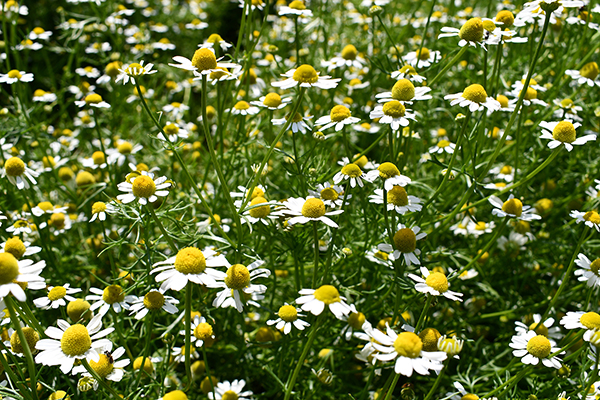
 Chamomille is a self-seeding plant, and it is in bloom right now. I am dehydrating these little daisy-looking flowers almost every other day. It is a large part of our herbal teas. Every year I witness life springing anew. It is a wonderful part of life to be able to see what looks like dead plants come back to life.
 Cosmos is a self-seeding flower that I have learned to fully embrace in our garden design. I pick the perfect place to put an area of plants that naturally re-seed themselves each spring, my workload is decreased by the self-seeder because I don’t have to plant them every earl spring. . I do have to manually weed this area but, I have to weed during the life cycle of any crop we plant.
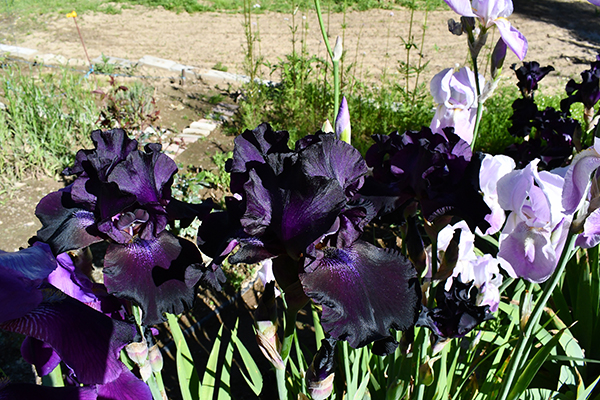 Iris is a colorful and fragrant part of early spring for us. They just don’t seem to last long enough each year.
 Daisies are a pleasure to see. We love the way that the Perennials keep coming back every year.

 Both the California (yellow) and Oriental poppies are blooming in a colorful array to be picked and dried to make teas and tinctures. The yellow California poppy blossoms are safe for non-narcotic teas and tinctures.


 Poppies are another container of flowers that are picked in the early morning to make tea and tinctures with. You can see the wide range of colors that they bloom in.
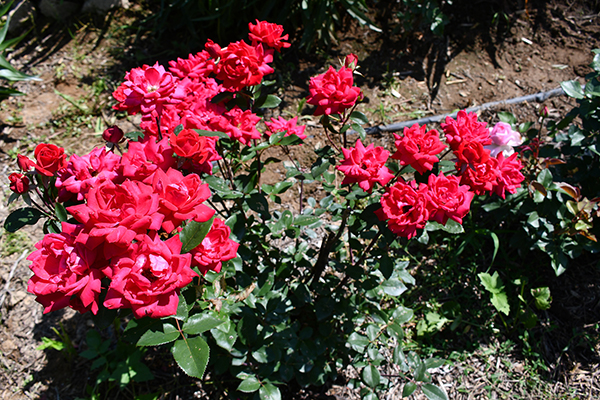 The roses are blooming and I collect their blossoms for use in making beauty creams.

 Let’s not forget the hollyhocks who have tall and graceful figures in the garden.
There are many other beautiful flowers across the garden. The bees, butterflies, and birds are very happy.
 Herbs, Pickles, and Salsa ingredients were picked today. Previous to this is a picture of my wagon after picking mints, rose petals, and asparagus a couple of weeks ago.
 Then some chamomile, poppy, and rose petals dry on the table. There have been many tea-making harvest days this year.
 My husband and I split up the chores between us. I am making a large bowl of salsa that will sit on the table for a couple of days letting the flavors mix. We stir and re-cover it whenever we pass by. It fills the house with a wonderful aroma for a couple of days. Then it is put in jars and hot water bathed for storage in the pantry.
 This morning I picked the first batch of chamomile blossoms in the herb garden. The little triangle slope is really pretty all covered in those little white “daisies”.
 This is a calming herb I use in a lot of the teas that we drink in our household. Their ethereal fragrance is sweetly unique and it hangs in the air as you spend time picking and inhaling their scent. Hence, I exit the chore in a relaxed and satisfied mood.
 Chamomille is a self-seeding annual herb that I appreciate not having to plant every year. I leave some blossoms remaining at the end of the year so they can drop seeds for the following spring. Here is how my chamomille patch looked after the snow melted this spring. Kind of desolate looking, but no worries.
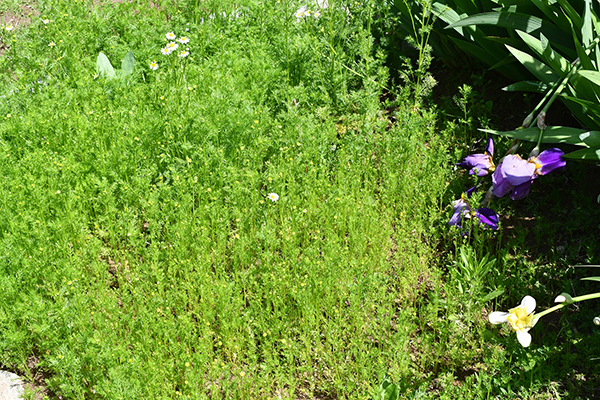 Before you know it there are green starts coming up even where you didn’t plant them. Just a breeze moves these seeds all over the garden.
 A couple of weeks later you have a patch covered with miniature daisies that are calling, “pick me” to you. This many flowers could seem like an impossible task. Rosemary Gladstar suggests a great manner of picking. Slipping my hand into the flowers I allow the stems to fit between my fingers. Then gently lift up and simultaneously decrease the distance between my fingers. At the stem tops, the flowers pop off and sit on the top of my hand. Before you know it, you are reaching down and scooping flowers. In order to ensure more harvesting, I avoid the buds that are not open all the way.
 We are enjoying being outside again. Checking out the herb and flower garden in the middle of our massive garden is fun. Things may look a little grim right after all the snow melts, but no worries. To identify what plant you are looking at, I label everything and place “birds of a feather” together. For instance, my herbal teas are all in one area.
 But will transform into this again after the seeds they dropped come back up.


 and last year.
 Lavender now,
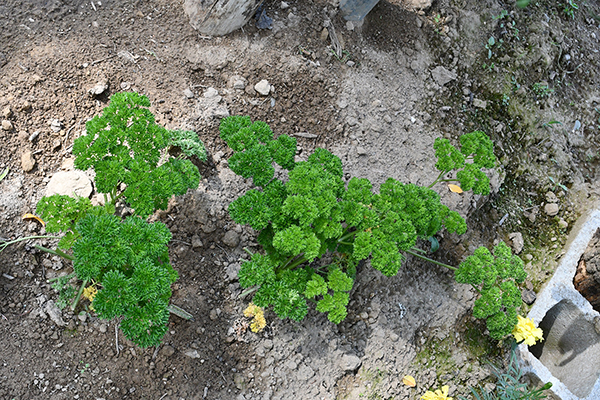
 Parsley now

 You get the idea, don’t you.